
How does a POS record a mobile money sale?
When a customer pays by MTN Mobile Money or Airtel Money, the POS should record the sale under that payment method specifically, rather than bundled into “cash”. That one distinction is what lets your end-of-day report show how much came in by mobile money versus cash, and it is what makes the drawer count balance at close.
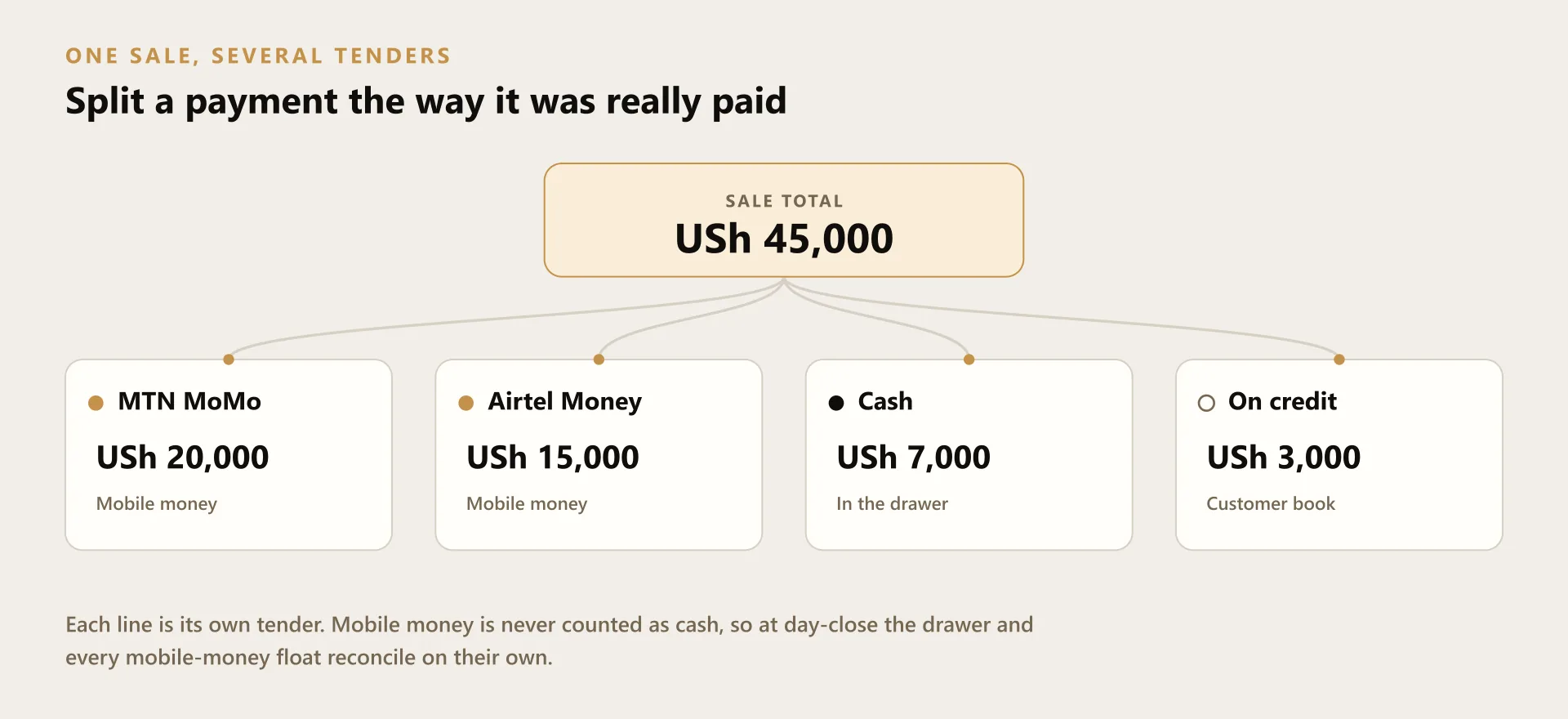
A good till also lets a single sale be split: part on mobile money, part cash, part on the customer’s credit. Real payments are messy, and the till should follow the money rather than force it into one box.
Does the till connect directly to MTN or Airtel?
This is where honesty matters, because “mobile money integration” is written on almost every feature list and means very different things. In most Ugandan shops, the practical flow is: the customer sends the money to your line, you see the confirmation on your phone, and you mark the sale paid by mobile money on the till. The POS records the tender; the network confirms the transfer.
Some larger setups use a payment aggregator that confirms the transaction automatically, but that adds cost and a dependency on a connection, which cuts against selling offline. For most shops, recording the tender and confirming on your own line is simpler, cheaper and works when the internet does not. Just be sure you know which model a POS is offering before you buy.
It is worth knowing who stands behind the money as well as the software: mobile money operators in Uganda are licensed and supervised by the Bank of Uganda under the National Payment Systems Act, and the Uganda Communications Commission publishes the sector statistics behind how much of Ugandan retail now moves this way. Your POS is recording a regulated payment, not an informal one, which is exactly why it deserves its own line in the books.
How do I reconcile mobile money at the end of the day?
At close, the till gives you a mobile-money total for the day. You check that figure against your MTN or Airtel statement for the same period. If they match, your day is clean; if they do not, you have a small, specific number to investigate rather than a whole day to unpick.
This is the quiet advantage of recording mobile money as its own tender from the first sale: reconciliation becomes a two-minute check instead of an evening of counting backwards from a single lumped total.