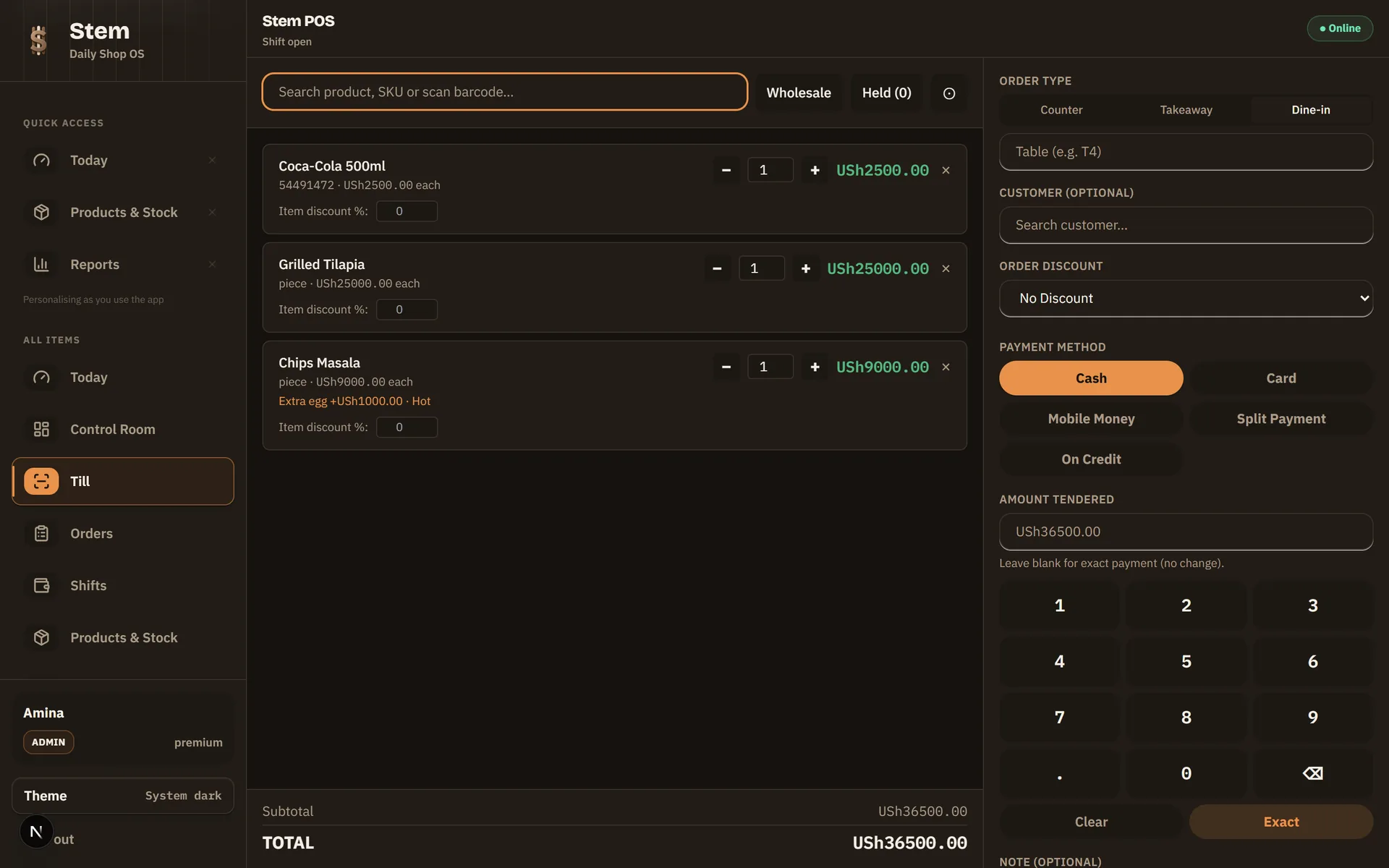
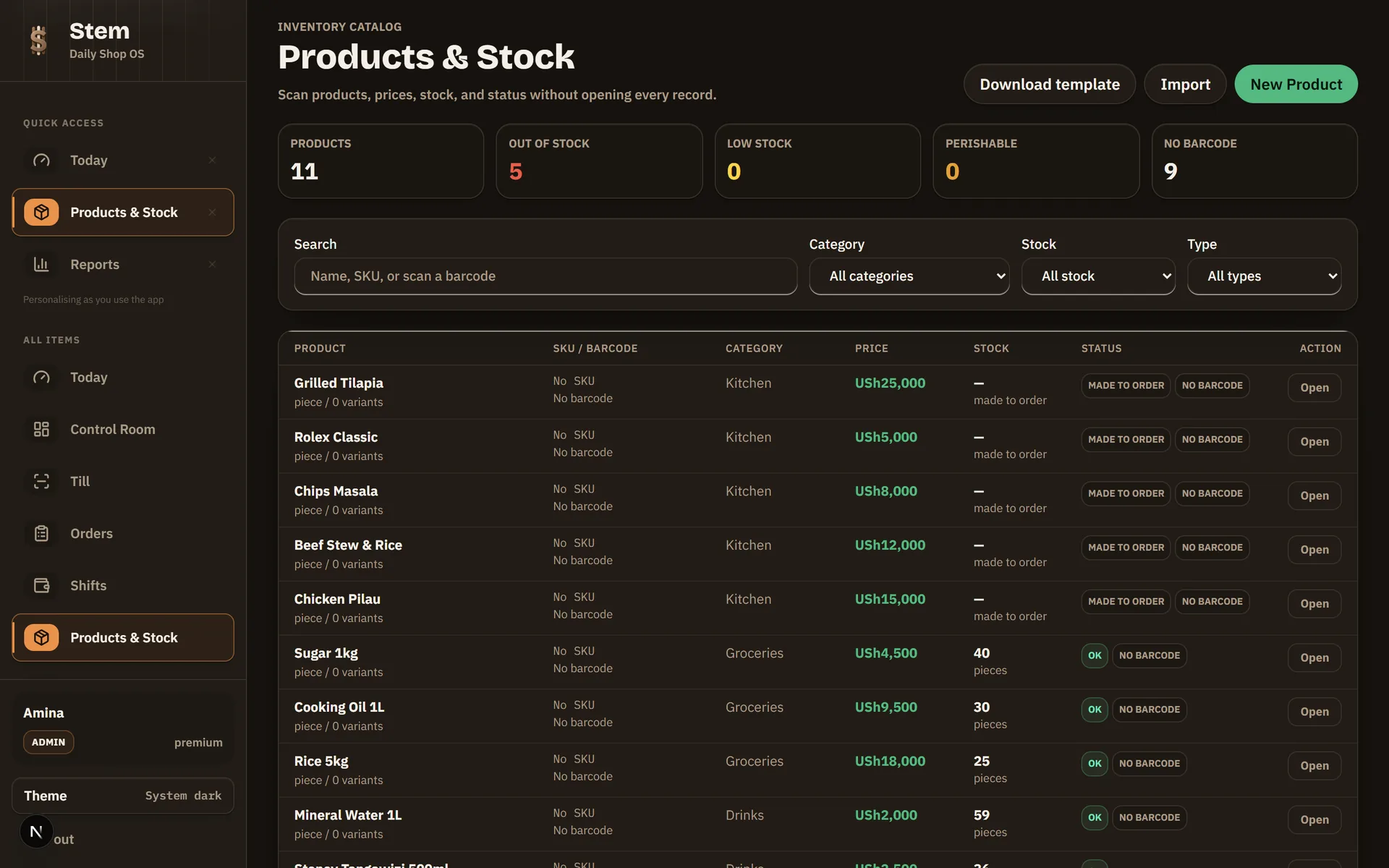
Phones, laptops, tablets and computers, every device tracked by its IMEI or serial number, warranty answered by scanning it, repairs and trade-ins that do not get lost, and Stem POS that keeps selling when the internet does not.
✓ IMEI on every phone✓ Warranty on a scan✓ Repairs & trade-ins✓ Works offline
Getting started
What does an electronics shop POS need that an ordinary till does not?
An electronics shop does not sell quantities, it sells specific objects. Six identical handsets on a shelf are six different phones, each with its own IMEI, its own warranty and its own history, and the questions a phone or laptop dealer actually gets asked are about one of them, not about the six. Which phone did you sell me. Is this laptop still covered. Is this one stolen. Where is the one I left for repair. A till that only counts stock cannot answer any of them.
How do I set my electronics shop up?
1
Open your shop as a Tech Store
Pick Tech Store when you register. Already on Stem as a retail shop? Ask us to switch you over, and you keep every product, sale and receipt you already have.
2
Turn on serial tracking for your devices
Mark phones, laptops and tablets as serial-tracked. Accessories and airtime stay ordinary stock, because not everything needs an IMEI.
3
Scan the consignment in
Paste or scan the IMEIs when a delivery lands, including the second IMEI for dual-SIM handsets. Two columns straight out of your supplier’s spreadsheet works.
4
Sell the exact handset
Ringing up a phone asks which one is leaving. That unit is bound to the sale, printed on the receipt, and inside the receipt’s signature.
What you get
Built around the handset, not the quantity
Every handset by IMEI
Each phone is a specific object, not a quantity. Scanned in at delivery with both IMEIs for dual-SIM, sold by name, and traceable for as long as you keep the records.
The receipt names the phone
The IMEI prints on the receipt and sits inside its digital signature, so a warranty claim months later has proof that cannot be edited afterwards.
Warranty answered by scanning
Scan a customer’s handset and the counter says “in warranty until 14 March 2027” or “expired”. The cover is fixed at the moment of sale, so changing your policy later never shortens what someone already bought.
A repeated IMEI is flagged
If an IMEI arriving in a delivery has been seen before, Stem says so and says where. A duplicate IMEI is how a counterfeit handset shows up, and UCC can lock those off the network long after you have sold them.
Repairs do not get lost
A device on the bench has a state of its own: a customer’s own phone is held in your custody and can never be sold by mistake, and your own stock out with the supplier stops being promised to someone else.
Trade-ins with honest margins
Take a used device in at an agreed value and grade, record what you spend putting it right, and it returns to stock at what it truly cost. The margin on a refurbished phone stops being a guess.
One shop, one shelf
Stem POS only sells the handsets that are in its own branch. If a phone is at another branch the counter is told which one, so it can be transferred rather than promised.
Stock-take by scanning
Counting “seven phones” does not tell you which seven. Scan the shelf and Stem names exactly what is missing, what is unexpected, and why.
In detail
The four that decide it
A policy change can never shorten cover somebody already paid for
Warranty is written onto the handset at the moment it sells, not worked out later from your current policy. So if you move from twelve months to six next year, every customer who already bought a year still has a year. Systems that calculate expiry on the fly quietly take that back, and nobody notices until someone is turned away at the counter holding a receipt that was honest when it was printed.
A printed number can be altered. A signed one cannot.
The IMEI does not just appear on the receipt. It sits inside the receipt’s digital signature, alongside the same verification QR every Stem receipt already carries. Anyone can scan that code and confirm the receipt is genuine and unedited, including the handset it names. For a warranty claim two years later, that is the difference between a document and a piece of paper with a number typed on it.
“We lost your phone”
It is the worst sentence in a repair shop, and it is almost never theft. It is a device that went onto the bench and came back as nothing, either still marked sold or quietly put back on the shelf. A customer’s handset in Stem is held in your custody rather than counted as your stock: it cannot be sold by mistake, it cannot be deleted, and it keeps its link to the original sale and warranty the whole time it is with you. Your own stock sent back to a supplier gets its own state too, so it stops being promised to customers while it is away.
What the refurbished phone actually cost you
Take a device in at an agreed value and grade, then record what you spend putting it right. It returns to the shelf at the total, not the buy-back price, so the margin you read is the margin you made.
Paid for the trade-in
200,000
Parts and labour
80,000
Back on the shelf at
280,000
Costs add up against the handset as you spend them, so the last repair is not mistaken for the whole bill.
At the counter
The answers where the customer is standing
An electronics shop receives stock at the counter and answers warranty questions at the counter, which is often exactly where the connection is worst. So Stem POS for Windows does both without one.
Scan a customer’s handset at the counter and see instantly whether it is yours, whether it is still under warranty, and who bought it.
Scan a delivery in from the counter, with no internet. It is recorded straight away and becomes sellable the moment Stem POS syncs.
The device list in Stem POS is your branch’s shelf, so a phone at another branch is never offered to a customer standing in front of you.
The difference
What does a device register do that a notebook cannot?
The question
A notebook
Stem
Which phone did we sell him?
A price in a book, no IMEI
The exact IMEI, on the receipt and in its signature
Is this still under warranty?
Find the receipt, count the months
Scan it, and the counter answers
Have we seen this IMEI before?
No way to know
Flagged at delivery, with where it was seen
Where is the customer’s phone we took in?
Ask whoever took it
On the bench, in your custody, and unsellable by mistake
What did that refurbished phone cost us?
The buy-back price, if anyone wrote it down
Paid plus every shilling spent fixing it
Is it still there?
Count them and hope
Scan the shelf, and Stem names what is missing
Questions
Electronics shop POS: common questions
›Does Stem track phones by IMEI?
Yes. Every handset is scanned in at delivery by IMEI, including a second IMEI for dual-SIM phones. Selling asks which exact unit is leaving, and that unit is bound to the sale line, so months later you can answer which phone went to which customer.
›Does the IMEI print on the receipt?
Yes, and it sits inside the receipt’s digital signature rather than just on the paper. That matters for a warranty claim: a printed number can be altered, a signed one cannot.
›How does warranty work?
Set a warranty period in months on the product. When a phone sells, its expiry date is stamped onto that specific handset. Scanning it later tells the counter whether it is still covered. Because the date is fixed at the sale, changing your policy afterwards never shortens cover a customer already paid for.
›Can Stem warn me about counterfeit or duplicated IMEIs?
Stem tells you when an IMEI arriving in a delivery has been seen before in your own records, and whether that was on your shelf or on a phone you sold years ago. The same IMEI cannot legitimately arrive twice, so a repeat is the strongest signal available to you, and you did not need anyone else to find it. Stem does not query UCC’s register for you: that check stays with *197*4# on the handset, or the checker at simu.ucc.co.ug. Our guide on checking a phone is genuine in Uganda walks through both.
›What happens to a customer’s phone left in for repair?
It is booked in as a device in your custody. Stem records that you are holding it, keeps it linked to the original sale and its warranty, and will not let it be put into stock or sold by mistake. Your own stock sent back to a supplier gets its own state too, so it stops being promised to customers while it is away.
›Can I take trade-ins?
Yes. Record the device, the grade you agreed and what you paid for it. While you are refurbishing it, every cost you add builds up against that handset, and when it goes back on the shelf it does so at what it actually cost you. The trade-in value itself is settled on the sale in the normal way.
›Does Stem POS work without internet?
Yes. Stem POS for Windows holds your catalogue, prices and customers on the machine. Selling, receipts, credit and scanning a delivery in all work with no connection, and everything syncs when the internet returns.
›I already sell phones on Stem as a retail shop. Do I have to start again?
No. A retail shop can be moved to Tech Store keeping everything it already has: products, stock, orders and receipts. It gains the device side rather than replacing anything.